

Betara, Biu and the Politics of Grassroots Legitimacy By Lawan Bukar Maigana
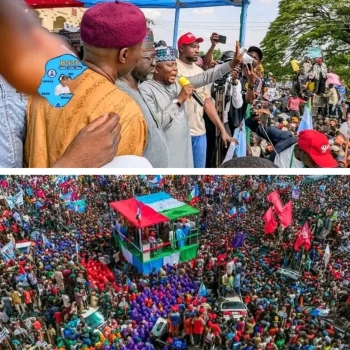
There was something unusually defiant about the manner in which Muktar Aliyu Betara addressed his supporters in Biu after the recent primary elections.
It was not the desperation often associated with politicians struggling for relevance. Neither was it the exaggerated bravado that frequently accompanies those seeking validation from political elites. Rather, it was the confidence of a politician who appears fully aware of where his strength comes from—and unafraid to say it publicly.
Rt. Hon. Mukhtar Aliyu Betara represents Biu/Bayo/Shani Federal Constituency of Borno State in the House of Representatives across multiple terms — serving on key committees including NDIC, Banking and Currency, Interior, Army, Defence, and Appropriations. He currently chairs the House Committee on the Federal Capital Territory (FCT) — one of the most strategic committee positions in the 10th House of Representatives.
Standing before a massive crowd in his hometown, Betara did not sound like a man waiting for endorsement from power brokers in Abuja or Maiduguri. He sounded like someone who believes he has already been endorsed by his people. Perhaps that, more than anything else, explains the certainty in his voice.
In Nigerian politics—particularly within ruling parties—power often flows downward from elite structures. Candidates are selected in closed meetings, decisions are made far from local communities, and voters are expected to accept names handed to them from above.
But in Biu, Betara openly challenged that culture.
“Please, for Allah’s sake,” he repeatedly appealed to the crowd, “when it comes to State Assembly representation in Biu, don’t involve yourself in it. Let us do our thing in Biu. Don’t write a name for us from Maiduguri.”
It was more than a campaign remark.
It was a direct warning against political imposition—the long-standing practice where communities are expected to accept candidates chosen elsewhere, regardless of local acceptance or competence.
The crowd’s reaction revealed something many politicians spend decades trying unsuccessfully to build: organic loyalty.
Thousands gathered around him not because they had been assembled for a rented display of political strength, but because they appeared genuinely connected to his message and leadership style.
That distinction matters.
In an era where many political rallies are sustained through logistics, inducements, and orchestrated mobilisation, spontaneous public enthusiasm remains one of the rarest currencies in Nigerian politics.
Even more striking was the confidence with which Betara spoke about electoral influence.
“The same votes they will give me is the same votes they will give every APC candidate,” he declared.
The statement carried unusual weight—not because it was politically dramatic, but because the audience genuinely appeared to believe him.
In a political environment where many elected officials struggle to return to their constituencies after elections, Betara’s relationship with his constituents appears unusually resilient. While some politicians survive primarily through party structures and godfather networks, he increasingly projects the image of a politician whose legitimacy is rooted directly in grassroots acceptance.
Across Southern Borno, supporters frequently point to projects they say have transformed communities and improved local realities.
Among these are roads, markets, police and DSS offices, and a modern mini sports stadium with a seating capacity of over 1,000. But perhaps even more politically significant is the youth empowerment narrative surrounding his interventions.
Reports that about 500 youths received financial support of one million naira each naturally resonate deeply in a region battling unemployment, insecurity, and economic hardship. Whether viewed as empowerment, welfare politics, or strategic constituency engagement, such interventions inevitably deepen political loyalty.
Read Also:
There is also the establishment of a National Open University study centre in Kwaya Kusar—a project many residents interpret as a long-term investment in education and human capital development.
What becomes evident is that the projects associated with Betara are not random. They cut across infrastructure, security, education, commerce, and youth development.
More importantly, they are visible.
And in Nigerian politics, visibility matters.
People rarely defend leaders whose impacts they cannot physically identify within their communities. That may explain why Betara increasingly speaks with the certainty of someone convinced that his constituents have seen enough to trust him repeatedly.
During his speech, he also touched on another politically sensitive issue—his relationship with Babagana Umara Zulum.
According to him, efforts had previously been made to create political tension between the two men. Yet he dismissed such attempts, insisting that his bond with the people remained intact because of what he had delivered to them over the years.
“What I have done for my people,” he declared, “nobody can do it for them in Biu in the next twenty years.”
To outsiders, such a statement may sound exaggerated. But politics in many rural communities across Northern Nigeria operates differently from elite political conversations in Abuja.
Loyalty there is rarely built through speeches alone. It is often tied directly to visible interventions and perceived accessibility.
Perhaps the most politically consequential moment of the gathering came when Betara addressed support for President Bola Ahmed Tinubu.
At a time when economic hardship has generated mixed reactions toward the Tinubu administration across parts of Northern Nigeria, Betara appeared determined to publicly align himself with the President.
“People say nobody can campaign for Tinubu anywhere,” he told the crowd. “Let me tell you, I will campaign for him completely in Biu.”
Then came the symbolic exchange.
“Nigeriaaaaa!” he shouted.
“Sai Tinubu!” the crowd responded thunderously.
He repeated it several times, and each response came back louder.
For Betara, support for Tinubu within Biu appears connected less to abstract national politics and more to local realities. According to him, many people “see Tinubu through him” because they associate governance with the projects and opportunities facilitated in their communities.
That observation reflects an enduring political truth often overlooked by analysts: in many parts of Nigeria, politics remains deeply personal and localised.
Citizens are more likely to support leaders whose impacts they can physically see, touch, and directly benefit from.
His speech also indirectly exposed the vulnerability of another category of politicians—those who spend years in office without leaving visible footprints in their constituencies.
Across Nigeria today, many elected officials struggle to defend their records because constituents cannot identify meaningful projects attached to their names. Some even resort to emotional appeals for second chances rather than presenting tangible achievements.
The contrast between such politicians and Betara could hardly be sharper.
One speaks from political vulnerability.
The other speaks from perceived performance.
What unfolded in Biu therefore felt larger than an ordinary political gathering. It reflected the growing confidence of a politician who believes his legitimacy comes not from elite arrangements or imposed consensus, but directly from the people themselves.
Whether that influence ultimately translates into greater political dominance remains uncertain. Politics is fluid, loyalties evolve, and power equations can shift unexpectedly.
But for now, one reality appears difficult to dispute:
In Southern Borno, Muktar Aliyu Betara is increasingly speaking—and behaving—like a politician convinced that his people are firmly behind him.
Lawan Bukar Maigana is an award-winning humanitarian communicator and can be reached via email: [email protected]