
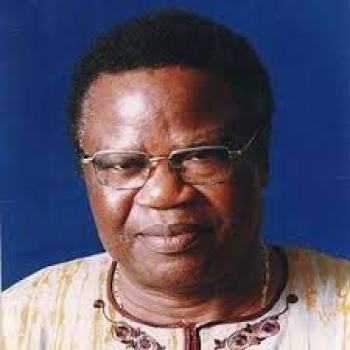
Prince Tony Momoh was, indeed, an accomplished personality, especially in public service and politics. He demonstrated outstanding excellence and patriotism with dual professional competences as a journalist and a lawyer. For his immense contributions to the development of Nigeria, SUNNY IDACHABA writes that he remains unforgettable.
Prince Tony Momoh, a notable journalist, was the former Minister of Information and Culture under the former military president, General Ibrahim Badamasi Babangida, from 1986 to 1990. A prince from Auchi in the present Edo state, he was the 165th child of King Momoh I who had 48 wives, an exceptionally large polygamous home even by African standard.
Aside holding the public position of information minister, he was at the later part of his life chairman of the Congress for Progressive Change (CPC), the party formed and led by the former president, Muhammadu Buhari, which later merged with other political parties to form the present ruling All Progressives Congress (APC). Until he died in February 2021, he was a loyalist and follower of Buhari.
He began his career at the defunct Daily Times of Nigeria as a sub editor way back in 1962 and rose to become its editor. Subsequently, he rose to the top and held management positions in the organisation. In 1981, Momoh as a journalist was summoned by the Senate to explain the reason behind what the Upper House referred to as his media organisation’s ‘uncomplimentary’ and ‘contemptuous’ publication against the Senate.
In defending his stand, Momoh successfully argued his way out that as a journalist, he was empowered by the Constitution of the Federal Republic of Nigeria to hold government accountable on any subject matter that was of public interest. Aside being a journalist, he also studied Law and was called to the bar in 1975. His knowledge of legal matters helped to shape his practice of journalism a great deal.
As a Minister of Information and Culture under a military regime that reputedly dehumanised the press, Momoh had difficult moment handling the reputation of that regime, especially with regards to the incident surrounding the controversial death of Dele Giwa through a parcel bomb. Despite his public promise of following its investigation to the end, he later backed out due to inexplicable reasons. That probably was one of his major regrets in life.
After he was dropped from the cabinet in 1990, he landed another plumb appointment as Chairman, Board of Directors of the now rested Nigerian Airways, from 1991 to 1993. This is aside the fact that he was a member of Edo State Economic Advisory Committee in 1991 and member Nigerian Press Council in 1992.
In his life time, he was noted for his fearlessness and outspokenness, both in government and outside government. Writing on the life and times of Momoh, Iwok Iniobong, a public commentator, remarked that he was a strong ally of former Buhari who had consistently spoken about the need to restructure the country for democracy and good governance to thrive.
Iwok copiously quoted Momoh’s message to Nigeria during the country’s 60th Independence anniversary saying, “Democracy is a way you chose to grow the polity and it has to do with freedom. In our traditional society, freedom is earned, not donated. Even in developed countries, freedom is given as a function of growth. In other words, democracy, which is freedom, is the luxury of development. When you are developed, you enjoy it. That is so in our societies.”
Continuing, he stated that, “In Igboland, it is what you do that makes you have a red cap chief. It is what you do that makes you have a feather on that red cap. It is also what you do that makes you Eze or Igwe. In other words, you work to be entitled to what you do.”
According to Iwok, “As at 1996, Momoh was one of the directors of the Newswatch magazine which was said to have a circulation strength of 150,000 copies in Africa, Europe and North America at that time. Momoh, who served as Information and Culture minister under General Ibrahim Babangida between 1986 and 1990, was a prominent figure across the country within the last few decades especially the major political parties. For instance, he was director of Alex Ekwueme Presidential Campaign Organisation in 1999, chaired the screening and conduct of gubernatorial and state House of Assembly primaries in the Kano chapter of the PDP for the 1999 general elections, together with Abdullahi Sumaila and Senator Bala Tafidan Yauri.
“He also chaired the media and publicity of the defunct All Nigeria People’s Party (ANPP) Campaign Organisation in the 2003 and 2007 elections and chairman of the Political Committee of the Muhammadu Buhari Organisation,” Iwok wrote.
Another public commentator who wrote extensively about Momoh is Mack Ogbamosa who said if there was anyone who prepared himself adequately for his life’s career, it was Momoh. He said, “After Teachers’ Training College in his early life, he grounded himself in Mass Communications and Law to make himself a well-rounded professional in both fields. He was a renaissance man; a man of many parts. It was therefore no wonder that most of his contemporaries avoided arguments with him. They also warned other upcoming journalists to avoid arguments with Tony Momoh because he easily jumped from one discipline to another in order to confuse others in the course of any debate.”
Writing about his first contact with Momoh, Mack said, “Incidentally, my first encounter with him was not a physical one. I was reading a copy of the Daily Times newspaper in 1980 when I saw a story where Tony Momoh was said to have been promoted to Deputy Manpower Adviser of the Daily Times of Nigeria (DTN) Plc, after having served as the editor of the paper. That did not interest me much. What intrigued me was that the man had degrees in Mass Communications and Law. I immediately had a volition. This was the time I was trying to make up my mind on which career to pursue after having just passed my Advanced Level papers in Arts subjects the previous year through private study.
“In the course of time, I later encountered him physically as a journalism student, a journalist in the Daily Times, and as a lawyer in his chambers. He was the chairman of the board of governors while I was a student representative at the Times Newspaper Training Centre (TNTC), later Times Journalism Institute (TJI). He was the general manager of Times Publications Division (TPD) while I was a sub-editor in the Daily Times before I ended up as an associate in his law chambers while he was the principal coordinator. We worked together in all other areas, including media and publicity campaigns, as well as political consultancy for the late Dr. Alex Ekwueme and President Muhammadu Buhari until his body transited on Monday, February 1, 2021.”
He said in his more than 40 years of interaction with Momoh, he saw a man who stood for hard work, meritocracy, honesty, punctuality, reliability, integrity and humility. These virtues reflected in his daily activities. Mack said further, “He scored many firsts. He was the first known journalist in the country and the first Daily Times editor to empower himself with a degrees in Mass Communication and Law. He was the first editorial training manager of TJI. He was the first and only journalist who became editor of the old Daily Times through examination. He was the first and only general manager of the TPD to have been appointed minister of information and culture. He was the first and only minister to write letters to his countrymen.
“Despite the fact that the federal government held majority shares in DTN Plc while he was the editor, he did not hesitate to challenge members of the Second Republic National Assembly when they tried to interfere with his job. He took them to court and got a judgment that has become a landmark case in both Constitutional and Media Law Reports today.
“After working for Buhari for twelve years (2003 –2015) before he eventually won the election as president, he told those of us working closely with him that he did not expect any rewards because we did the job, not for material benefit but because we believed in the man – Buhari. That was typical of Tony Momoh.”
One remarkably, unforgettable fact about him was his penchant for writing letters. As information minister, he wrote severally, ‘Letters to my Countrymen’ in which he summarises government policies in a language that could easily be understood by Nigerians. He came, served and left the scene when the ovation was loudest. It is for this reason that he remains an unforgettable hero.