“`html id=”s7wthc”
“`
By Newspot Nigeria Politics Desk


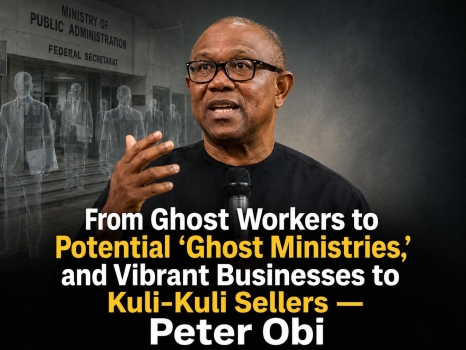
Former Anambra State Governor and Nigeria Democratic Congress presidential candidate, Peter Obi, has criticised what he described as worsening failures in Nigeria’s governance and economy, warning that the country appears to be moving from the era of “ghost workers” to the emergence of “ghost agencies” and potentially “ghost ministries.”
Speaking during an interview with media personality Chude Jideonwo, Obi used humour to express concern over recent questions surrounding accountability and oversight within the Federal Government.
“We used to have ghost workers because we didn’t do anything. Now, we have ghost agencies. Soon, we will have ghost ministries, ghost governors and ghost president,” Obi said.
His comments appeared to reference the controversy surrounding the Presidential Foreign Intervention Promotion Council (PFIPC), an organisation whose legal status has been disputed by the Presidency.
Advertisement

Sponsored


The controversy intensified following reports that the PFIPC appeared in the 2026 federal budget with an allocation of about ₦1.3 billion despite the Presidency maintaining that the organisation was never established or authorised by the Federal Government. Questions were also raised over how the organisation reportedly obtained office space within the Federal Secretariat in Abuja.
President Bola Tinubu subsequently directed the Independent Corrupt Practices and Other Related Offences Commission to investigate the circumstances surrounding the organisation.


Turning to the economy, Obi argued that economic hardship had affected many Nigerians who previously operated thriving businesses, claiming that some had lost their sources of livelihood and were now struggling to survive.
“Those who had business when he came into power have collapsed. They are now the people who are selling kuli-kuli?” Obi asked.
The former governor made the remark while responding to suggestions that the political movement behind his 2023 presidential campaign had lost momentum.
Obi rejected the claim, arguing that his support base had expanded as more Nigerians assessed the performance of the current administration through their personal economic experiences.
According to him, some Nigerians who supported President Tinubu based on his previous political record had reconsidered their positions after experiencing rising hardship and the collapse of businesses.
“Nobody can tell you things are moving well. What are they going to do now?” Obi said.
He also criticised the Federal Government’s Renewed Hope agenda, arguing that worsening economic conditions, hunger and insecurity had made it increasingly difficult for many Nigerians to believe that the country was moving in the right direction.
Obi maintained that the challenges facing Nigerians were no longer abstract political arguments but realities reflected in declining businesses, reduced purchasing power and the daily struggle of families to meet basic needs.
“Which hope are they going to renew again? You can’t renew failure, and that’s it,” he said.
— Newspot Nigeria


Sponsored